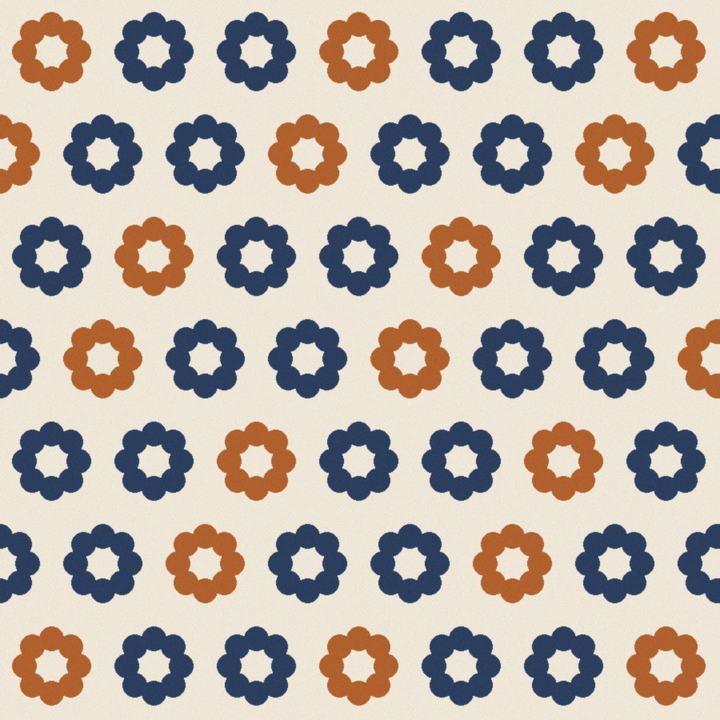
Block Print
In block printing the design is cut in relief into a wooden block, charged with colour and stamped by hand onto the cloth or paper. Each colour in the finished pattern needs its own block, and the blocks are registered against small pin marks at the corners so that the colours meet where they should. The method is old, slow, and still in commercial use, particularly in western India.
Its visual signature is registration that is nearly but not quite perfect. Colours overlap slightly in some repeats and fall short in others, the ink density varies as the block is recharged, and the surface of the wood leaves a faintly broken edge. Machine-printed imitations reproduce the motif and lose all of that, which is why they look flat beside the real thing.
Because the irregularity is spread evenly across the cloth, block prints tolerate being used in quantity. A whole room of a single block print rarely feels mechanical, whereas the same motif printed by roller often does.
The technique also explains the usual scale. A block that a person can hold and strike is limited in size, so traditional block-printed repeats are small to medium, and large designs are built by combining several blocks rather than by cutting one enormous one.