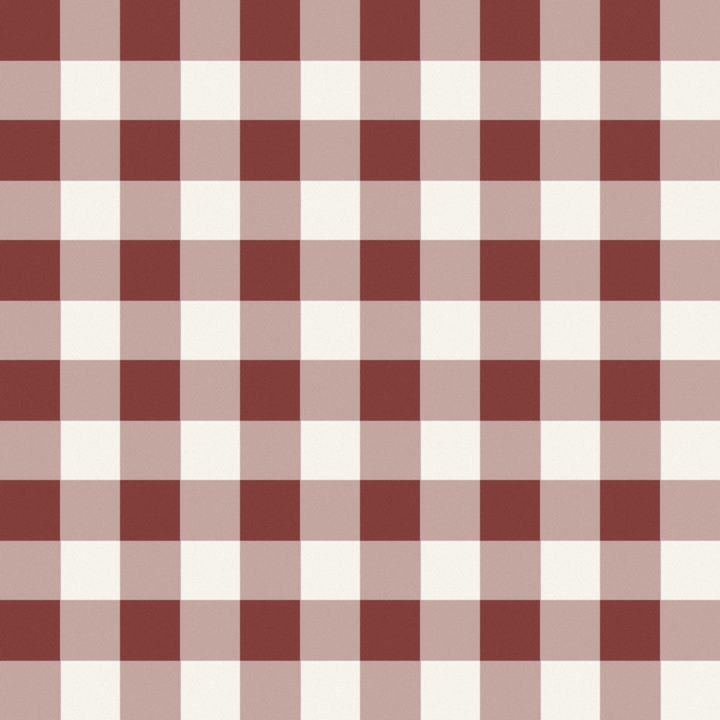
Gingham Check
Gingham is a plain-woven cotton check made from dyed yarn, so the pattern is identical on both faces of the cloth. The check is produced by alternating equal blocks of coloured and undyed warp and weft, which is why a gingham shows three tones and not two: the coloured squares, the white squares, and the half-tone where coloured warp crosses undyed weft.
That half-tone is what makes the pattern behave so well at a distance. It softens the grid and stops the check from reading as a hard graphic, so a gingham can be used at a much larger scale than its geometry suggests without becoming aggressive.
The cloth was a utility fabric long before it became a decorative one, used for aprons, linings, children's clothing and household cloths, and it retains that plainness. In a room it reads as unpretentious in a way that a printed check does not, and it is one of the safest patterns to use in quantity.
Scale is the main decision. A small check turns into a solid mid-tone at any distance, which is useful for a lining or a loose cover, while a large check keeps its geometry across a room and will carry a plain window or a plain wall on its own.