Trellis
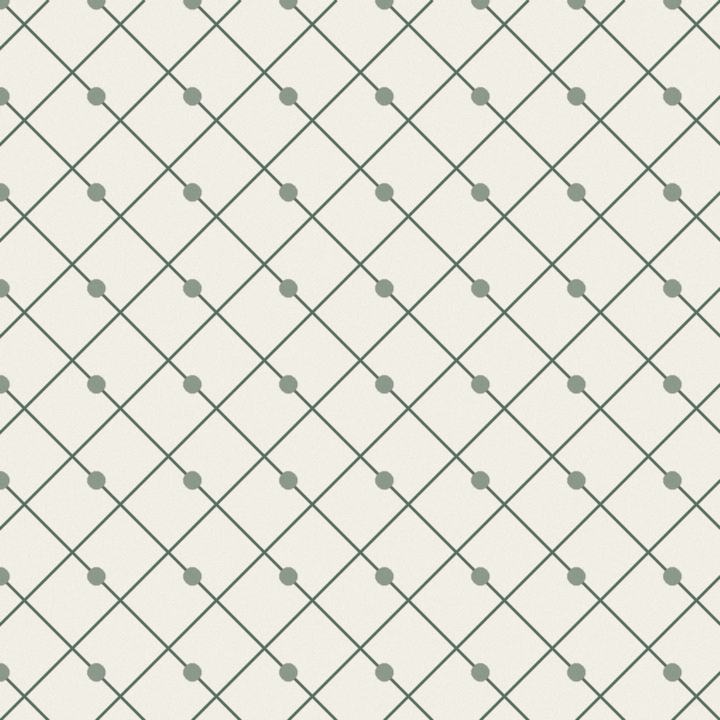
Trellis patterns take their geometry from garden lattice: a diagonal grid, usually with a small ornament at each crossing. The pattern has moved between materials for centuries, from actual timber lattice on garden walls, to painted treillage in eighteenth-century garden rooms, to printed papers and woven cloths that imitate both.
The diagonal is what makes it useful. A square grid on a wall competes with the architecture and shows every out-of-true corner in the room; a diagonal grid does neither, because the eye has no straight reference to compare it against. That is why trellis papers survive so well in old houses where nothing is quite square.
The ornament at the crossing controls how formal the pattern feels. A simple dot or knot keeps it close to the garden original; a flower or a rosette pushes it toward the drawing room. The lighter the crossing, the more the pattern behaves like a texture.
Trellis works particularly well in small rooms and on staircases, where a directional pattern would emphasise the awkwardness of the space and a symmetrical diagonal simply fills it.