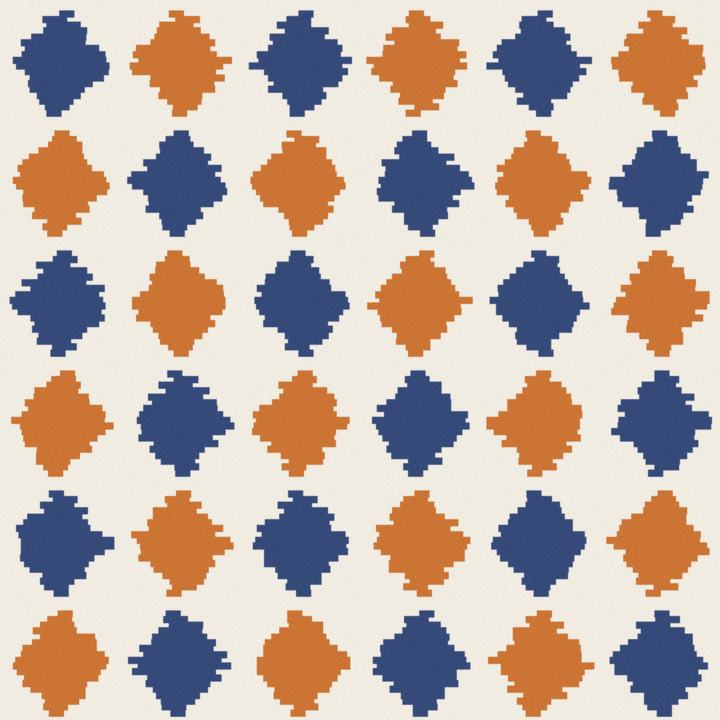
Ikat
Ikat is a resist-dyeing technique rather than a motif. The threads are bound in bundles and dyed before the cloth is woven, so the pattern exists in the yarn and not on the surface. Because no binding is perfectly precise and no warp is perfectly aligned on the loom, the edges of every shape come out feathered. That blur is the signature of the technique and the reason a printed imitation never quite convinces.
The technique appears independently across a very wide geography, from Central and Southeast Asia to Japan, India, and parts of Central and South America, and the local names and motifs differ accordingly. Warp ikat, where only the lengthwise threads are resist-dyed, is the most common; double ikat, where both warp and weft are dyed to meet, is the most demanding.
In a room ikat reads as pattern at a distance and as texture close up, which makes it unusually easy to place. The soft edge stops the motif from looking graphic, so a large ikat on a chair or a cushion will not date the way a hard-edged geometric of the same scale tends to.
It combines well with stripes, with plain woven linens and with almost any solid colour drawn out of the ikat itself. It is harder to combine with another blurred pattern, since the two tend to cancel each other into a general haze.